Fuel System

Anything fuel related will be under this title.

Shown below is the header tank with the fuel supply and return fuel lines secured.  The fuel lines are attached at three points with adel clamps.  Kind of over kill but that’s ok. Just need to be sure the seat and floorboards don’t rub.


The fuel valve is installed in the console and supply and return lines are hooked up at the firewall.


Note the check valve above on the return line.
Next are a couple pics of the fuel system on the firewall.

.

I did not receive the fuel pumps with the engine.  Rotax has had a problem with the ones manufactured lately.  I had Debra McBean file a claim for me.  I do not know when they will arrive.  When they do arrive this chapter will include the fuel pump assembly, fuel lines to the engine and lines from tanks to header.


Firewall Forward

It took 18 weeks to get my Firewall Forward package, Rotax 912iS, and the Airmaster propeller.  Just mentioning this to those of you that are starting out, plan way ahead.  It worked out for me.  I got the struts completed and a few other odds and ends.

Here are a couple pics of boxes and crates.


The first item on the list was to register the Rotax for warranty purposes.

I opened up the Airmaster boxes.  They do an excellent job shipping.  It was handled by DHL and USPS took care of the final delivery.  No damage.

Next was to do a physical inventory of the FWF package.  Everything was present and accounted for except for a few extra items that I called in for and requested that they be shipped at the same time.  No big deal, one email fixed it.

And now for a little assembly!

First up is to temporarily put the firewall on and fit the boot cowl.

Next is to install the engine mount.  This took a little effort because the upper two mounting holes were off a little bit as well as the bottom.  But in the end everything came into place.

Now for the fun part.

The above pic shows the Rotax hanging on my overhead hoist.  I have one strap around the gear box and two straps on the circle mount on the rear of the engine.  This way I was able to tip the engine to match the angle on the motor mount.

Here it is bolted up.

Got a thumbs up from Big Bird.

The next step in the assembly is pretty much left up to the builder.  I am going to wait fitting the cowl till later.  Next will be laying out the avionics and engine wiring.  I will split this part of the assembly into the FWF post and the avionics post.  Stay tuned.


Fusalage and Tail Feather covering

Now that the aft wiring, auto pilot servos, ADAHRS, and ELT have been installed it is time to cover the fuselage and tail feathers ( horizontal stabilizer, elevator rudder and vertical stabilizer).

Here is the bottom fabric glued and ready to shrink. 

I decided to work on a smaller piece next, the horizontal stabilizer.  It proved to be a challenge because of the rounded corners.

Here it is heat shrunk and ready for poly-brush.

Below shows the right side of the fusalage prepped and ready for fabric.

Continue reading Fusalage and Tail Feather covering

Avionics


I decided to install Dynon products in the Kitfox.  For the last couple of months I have been working with Advanced Flight Systems in Canby Oregon designing a VFR panel and putting together all of the needed components.

I picked up my early components which included the auto pilot servos.  The idea is to get everything installed in the aft part of the fuselage so that the covering can be completed.  The wiring for the horizontal stabilizer and trim sensor wire have been run.

Shown above is the elevator auto pilot servo being fitted.  Below is a pic the mounting bracket that I fabricated from some aluminum angle.  It is bonded to the frame and the linkage is fitted

Above shows the servo bracket painted and servo plus wire harness installed using DB9 connectors.

Below is a pic of the other side.

It’s a little hard to see but the aluminum triangle frame is for the ADAHRS to be mounted to.  Because the baggage area was extended I will need to install a remote magnetometer in the left wing tip.  Normally there is a location just behind the standard baggage sack to mount the ADAHRS.

Below shows the position of the ADAHRS.  It is mounted dead level with the fusalage floor.  A static port and the pitot tube are connected here.

Here are a couple of views of the roll auto pilot servo. It is mounted and wired in.

Another item to be installed is the ELT (emergency locator transmitter).  It’s a little hard to see but Kitfox has an antenna mount for the ELT.

About two weeks ago I picked up the completed system.  This is going to be “plug and play” for the most part. It was nice to see the entire system up and running.  All of the harnesses are made and tested by the AFS team.  I can not say enough about how good it is to work with AFS.  They also have great technical support.

Here it is temporarily mounted.  I will be painting the panel before installing of course.  There are a few empty holes.  The ones on the left and right are cabin vents.  The round one in the middle is for the Air Master prop controller.

The pic above and the one below shows some of the work that AFS did for me.  I temporarily hooked everything up just to get an idea of how the components would need to be arranged give the cable lengths and space available.

All of what you see in the two pictures above has been removed so that I can continue with the covering process.

Now that all of the fabric work and painting is complete it’s time to move into Firewall Forward and avionics.  See the FWF section for everything forward and this section for all avionics related topics.

Below are a few pics of the ECU.  It is not located where the factory does but it makes sense to me and frees up space on the right avionics tray.
I moved the heater core aft enough for the ECU to be mounted on the back side of the firewall.  It is spaced away from the firewall about a half inch to allow good airflow and room for some wiring to pass through.

Next is to get the panel installed but I wanted to get a glove box installed if there was room.  A good friend and fellow Kitfox enthusiast, Doug Pflugradt, gave me a Vans aircraft glove box that he didn’t have a use for. It was shortened to 8 1/2” and was the perfect size.  Below are a few pics of the glove box install and panel painting.  I used Rustoleum “Hammered” gray and took most of shine off with scotch bright.

I gave the paint about four days to cure and installed the components.  I was really looking forward to this. 

And now for the labeling.  My wonderful daughter, Hannah, has an electronic cutting machine that she used to make all of the labels.  I’m very pleased with the outcome.

And here it is installed.

All of my instrumentation is Dynon supplied by Advanced Flight Systems.  I had AFS make up almost all of the cables also.  Below are a few pics behind the panel.  It looks a little chaotic right now but will be tied off after everything is routed.  Every cable or wire is labeled for future reference.

I still have the EMS to complete, and a few odds and ends.  Not shown are the transponder antenna, com antenna, ADSB antenna or the GPS antenna.  I’ll get pics of those for next time.

I did get the head phone jacks installed.  I put them in the baggage area by the headset pockets.  I put the pilot jacks on the co-pilot side and the co-pilot jacks on the pilot side so that they are easy to reach inflight if necessary.  Below is a pic or two and notice the triangle windows are installed too.  I bought 1/8” tinted polycarbonate to match the rest of the “glass”.

I also installed the OAT probe in the left triangle window.  Easiest place to locate it out of direct light and a short run to the ADHARS.

Next up is to wire in the cab heater fans then move on to mounting the battery, solenoids and wiring that part up.  “Back to work”.

I’ve pretty much finished with the wiring.  I still have to check out and tie off everything behind the panel.  Forward of the firewall the Kavlico fuel pressure valve and the fuel flow transducer need to be wired but I will wait until the fuel pumps are installed.

Below is a pic of the mass of harnesses behind the panel and a look at the Ray Allen G405 grips.  I used shrink tube on the control rods rather than paint.

The G405’s have a PTT, trim up, trim down, auto pilot disconnect/connect, and a spare switch, hummm possibly a smoke system in the future?


Wing tips

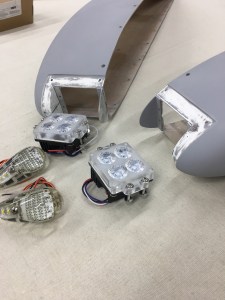
This is is a closer look at the lights and tips.  I put a lot of time into this but I am happy with the outcome.

The landing lights I purchased from a great guy, Josh Esser, from Canada.  Looking forward to turning them on Josh.

The nav lights are Avio from Poland.  Looking forward to turning them on too.

Here I finally have a landing light fitted.

The aft edge edge had to be split because it was too narrow.  The leading edge had to be split also because the shape was all wrong.  This pic shows the first application of super-fil.  I lost track of how many coats it took.

I must admit that I was not looking forward to doing this step because body work is not my strong suit, I can get it done, it just takes me forever.

The upgraded wing tips were very rough to start out with.  It took a lot of trimming and sanding to get them fitted properly.  This first pic shows the right tip clecoed in place. Looks easy, HA!

I put the finishing touches on the wing tips and am happy with the result.


Extended Baggage Area

This is what the factory baggage area looks like.  There is an option to extend the area aft which I am going to do.

This shows the seam taken out and an aluminum hinge attached to the original board.  Two more plywood pieces will make up the extended area. The first piece is attached to the hinge on one end and the other end is bolted. The rear ply is bolted in the four corners.

Next templates were cut out to use as patterns for the fabric, which is 500D Cordura.

The aluminum tube is held by adel clamps and rivnuts inserted into the ends of the tubes. These rods will support the new baggage sides.

Here is another view of the rod. One on each side.

And now for a little assembly!

Many thank to my talented daughter, Hannah. She brought her sewing machine, supplies, and talent to my shop and did a fantastic job putting this together.

The new area is velcroed in the same manner as the original.

On final assembly there be “D” rings spaced along the sides to use as anchor points for a cargo net.  We would not want anything sliding aft and upsetting the balance.


Rib Stitching

Prepping for rib stitching. This shows chalk lines and reinforcing tape on each rib. Both wings ready to lace.

The stitching is not very hard to do once you understand the knots. It took me a couple of days. This pic shows the single knots under the fuel tank ready to trim off the ends. I used a small zip tie with the head cut off as a “needle”.

Rib stitching completed

Rib stitching is complete. Next is to shrink the fabric the final time to 350 degrees with my calibrated iron.

Covering continued

Here is one of the drain hole grommets. Still need to melt the center out.

So this completes the covering process for the wings except for the wing tips.  They still need to go into the paint booth for additional coats but I will wait until all of the other control surfaces are ready.

These are doilies I made for the drain holes that are located on the trailing edge between each cap strip.

Doilies were poly-brushed in place around the lift strut brackets, fuel caps, inspection rings, jury strut brackets and pitot tube.


The next step was to apply the finishing tapes to the cap strips, false ribs and the leading and trailing edge. Inspection rings were next.


After the rib stitching was completed the fabric was ironed to 350 degrees with the calibrated iron, and a coat of poly-brush applied.

8188BA71-943F-4EFC-A24A-C928AC86DF5B
It’s been several weeks since I have posted but the wings are coming along nicely. This pic shows the root end top and bottom fabric glued and trimmed. This i has been completed on both wings plus the wing tips.
EDB25EB3-2CB7-434B-87E3-7740C4D1D030
A Kitfox wing has a laminar flow, meaning the bottom surface is concave so to hold the fabric tight to the rib it must be glued and laced. More on this later. This pic shows the bottom of the wing, notice that the fabric is glued to the ribs.
36685485-13CC-4DFA-A9B9-9C3136E106E3
Here the fabric is being heat shrunk to 250 degrees.
87650920-7D63-4127-BA59-26EB47C7296D
This shows the upper side shrunk to 250 degrees also. Next is to apply reinforcing tape to the ribs and do the lacing. After the rib lacing is complete the fabric will be heat shrunk to 350 degrees with my calibrated iron.
60CA3DC1-626A-4A94-8B72-44E6E11EC95B
This shows the front strut attachment…
21E0AFD1-4C9B-4341-AC49-95A75AE3F856
and the rear strut attachment. There will be doilies around these points and on other protrusions.
313F05A3-2549-4D40-A87E-4B83825DC120
This is just a simple way of testing the pitot tube
FDAF273F-0785-4681-A077-053FA2D59CB1
I opted to route the pitot tube behind the fuel tank rather than al the way to the tip of the wing and through the rear spare.
CA604E0C-CE6D-477F-8A1B-E45FDE286F0A
This shows the left wing tip. Notice the aluminum strips bonded and riveted to the end cap strip. These are for attaching the fiberglass wing tips.

Covering.

06A86527-1B64-40DC-B05C-CE0B10587B3A
I have finally finished prepping the wings and they are ready to cover. I will be using the Poly-fiber system. On the table are all of the Poly-fiber products used to attach the fabric. I chose the Poly-fiber system because of its proven track record. There are a lot of steps and time in the process but it’s pretty straight forward. I set up a 16 foot table for cutting the fabric and I can set a wing on it if needed.
71C8114F-1327-44B5-BEF0-85490DBD89E2
These saw horses and padded 2×4’s will hold the wing during the covering.
57679F5D-FE00-457F-85D4-D463AED485FD
Cutting the fabric is easy. Just measure it TWICE, mark with a pencil and straight edge, apply Poly-tax (glue) to the line and cut with a scissors. The glue keeps the fabric from fraying.
EE8F1F38-EE29-43D3-9BF9-B4E13A20C1A9
These two pieces of thin Aluminum reinforce the fabric around the forward strut attachment. I fashioned a half cone and riveted them as shown. They will allow easier access to the nut and a wrench when installing the struts. Another builder, John Evans, gave me the idea. Thank you John.
B15AA99A-AA94-4957-852C-8131B9FF091B
Another view.
16BAB5B7-09C3-44E9-BEE9-0FEE0EC6E739
Here I am with the first piece of fabric. Wish me luck.
8571FFBC-C3DE-4857-9F37-4A2C9240D13E
Here is the first piece bonded on the bottom of the right wing.
EABC9377-A405-4294-B1A7-3DFAB64AE720
Top piece ready to bond.
8631F7C0-90FA-46FE-B1FE-2B3FE1EFF4E9
Top and bottom are bonded and it’s time to do the root rib. I started with the bottom piece of fabric, rolled it around the cap strip and glued it in place.